Okavango Delta Safari: Best Time, Costs & How to Choose a Camp

The Okavango Delta breaks the normal rules. Rain falls in Angola between November and April, then takes about four months and over 1,000 kilometres to reach Botswana — so the flood arrives in the middle of Botswana’s dry season, and the Delta is at its fullest and best for wildlife exactly when the land around it is driest. It is a river that never reaches the sea: it spreads over the Kalahari sand and disappears, leaving roughly 15,000 km² of channels, islands and floodplains, swelling to about 20,000 km² at peak flood — a UNESCO World Heritage Site.
It is also one of the most expensive safaris in Africa, and one of the easiest to book wrong: the same three nights can be a water trip or a land trip, depending on your camp and month. This guide explains the flood, when to go, what it costs, and how to pick a camp that matches the water. Start with the bigger picture: African Safari Beginner’s Guide.
Quick answer: when, how long, what it costs
- Best time: June to October. Peak flood June–August for the classic mokoro experience; September–October for the most concentrated game.
- How long: 3–4 nights.
- What it costs: roughly $1,950–6,000 per person (operator ranges, November 2026).
- How you get there: fly into Maun, then a light aircraft to your camp.
The flood, explained: Angola to Maun in four months
Rain over the Angolan highlands (November–April) gathers into the Cubango and Cuito rivers, flows through Namibia’s Caprivi strip, and spreads across the flat Kalahari sands of Botswana. The journey takes roughly four months — which is why the flood peaks in the dry season, months after the rain fell.
But “peak flood” is not one date. It is a slow wave moving down the Delta: the Panhandle gets its water around late May; the central Delta (Moremi, Chief’s Island, the big concessions) peaks June to August; the water only reaches Maun and the southern Delta around August.
Most guides skip this first decision: a camp near Maun booked for June may still be waiting for its water, while a central Delta camp in September is already watching it drain away. When you read “best time June–October”, ask: best time where?
Month by month: water, wildlife and price
- November–March (green season): rain falls on the Delta itself. The flood is gone, but the land is green, birds arrive in huge numbers, and rates run roughly 20–40% lower than peak. Some camps close; those open are quieter and cheaper.
- April–May: transitional — the flood is on its way but has not arrived. Good rates, improving game viewing as the bush dries; the Panhandle starts to fill in late May.
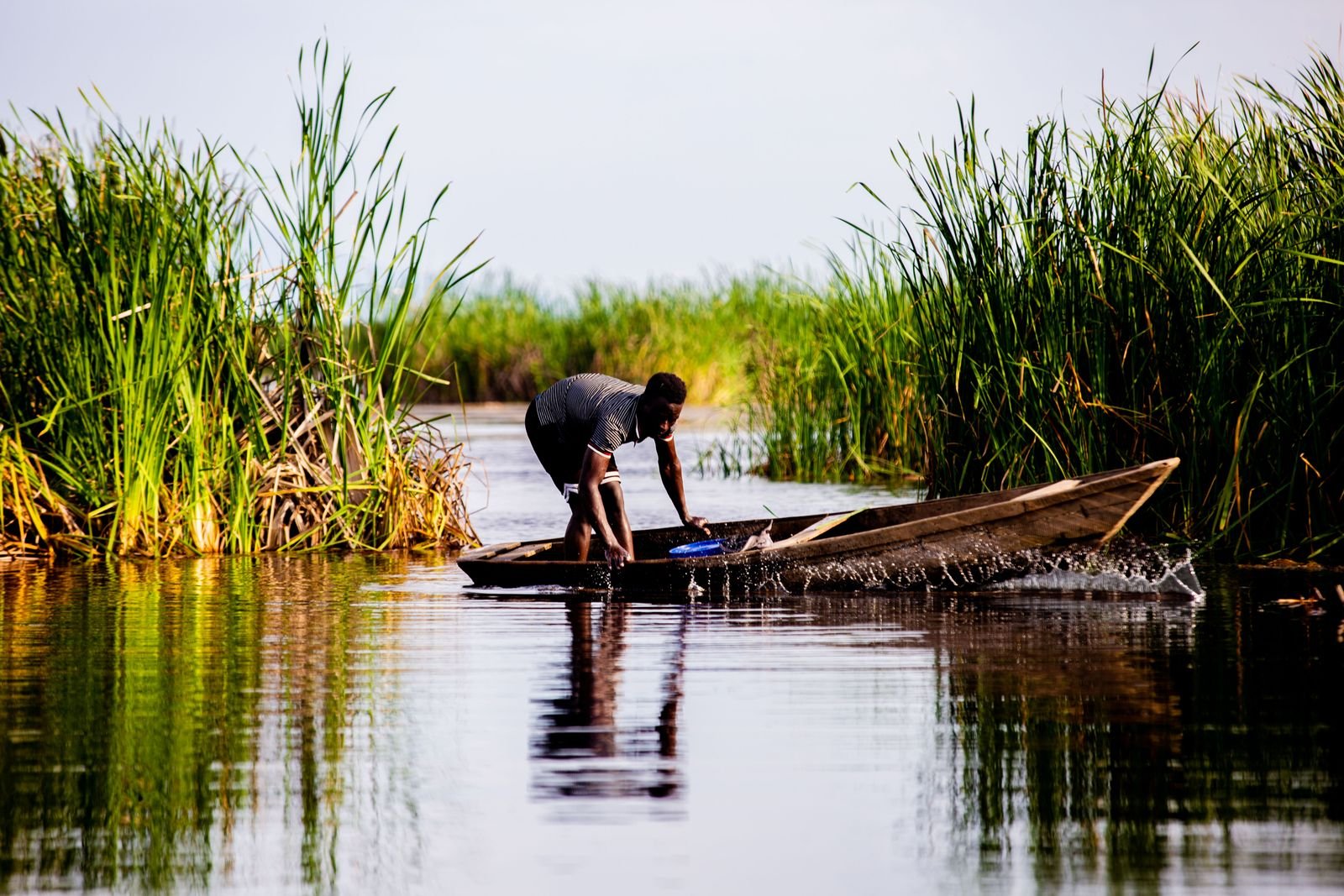
- June–August (peak flood): the classic Okavango: mokoro rides through the channels, walking on the islands, the full water world. Also peak price season — camps book up months ahead.
- September–October: the hottest months, and the most concentrated game: the water recedes, animals gather at the remaining pools, and predators follow. Land viewing is at its best — but by late October some channels are too low for mokoro rides.
Our verdict: if the mokoro is the reason you are going, book June to August in the central Delta. If game viewing matters more, September to October gives you more animals in less space, usually for less.
Land camp, water camp or both?
This choice decides what your days look like. Every camp is one of three kinds. Water camps sit in the permanently flooded areas: mokoro rides (a dugout canoe poled by a guide), boat trips and island walks are the core, with almost no game drives — the ground is under water. They shine June to August. Land camps sit on the dry islands and in Moremi: game drives and walking safaris are the core, with mokoro rides only when the water is high enough. They are the safer year-round bet. Mixed camps in the private concessions offer both — water when the channels are full, drives when they are not. They cost more — but the season cannot take your main activity away.
The honest downside nobody prints: a water camp booked in the wrong month can lose its reason to exist. Late-season channels run too low for mokoro rides, and a camp with no drives to fall back on is a very expensive place to watch the water leave. Booking September or later? Ask the camp what activities run in your month — in writing, before you pay.
The areas: Moremi, Chief’s Island, the concessions, the Panhandle
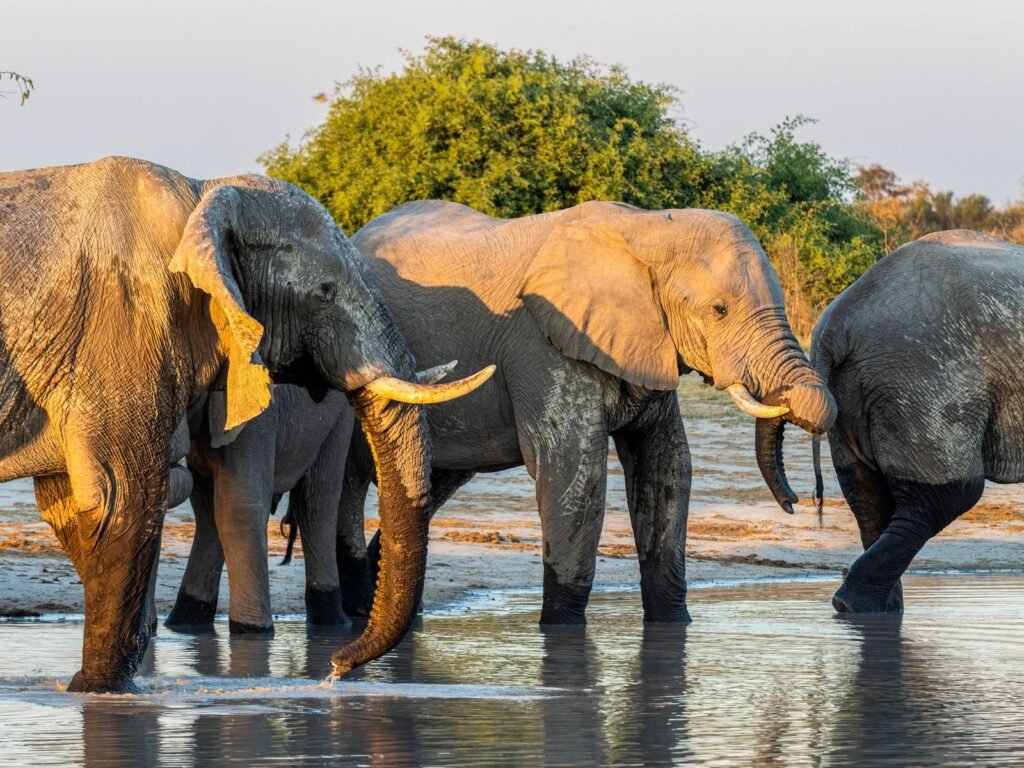
Moremi Game Reserve is the public reserve at the heart of the Delta, and the only place you can self-drive. It holds the predator country around Chief’s Island, the Delta’s largest island. The private concessions around Moremi offer the same wildlife with fewer vehicles, night drives and walking safaris — and the highest prices. The Panhandle, the narrow northern channel reached by road, floods first (late May) — and is where the budget routes start.
What it really costs
Per person per night, ranges across operators and platforms at writing (November 2026) — not quotes; green-season rates can run 20–40% lower.
- Budget / participation camping: roughly $150–350. Basic, often mobile.
- Mobile camping: from about $300. Proper tents, a guide and a cook.
- Mid-range permanent camps: roughly $600–1,300.
- Luxury fly-in camps: roughly $700–2,000+; flagship peak-season camps run $1,500+, and the very top reach about $5,000.
- A typical trip: 3–4 nights at a mid-to-luxury camp: around $1,950–6,000 per person, before flights.
The line item almost nobody adds up: bush flights cost roughly $350–700 per person per leg, and a normal trip needs at least two — $700–1,400 per person before you have slept a single night, usually quoted separately from the camp rate. Add it to your total before you compare prices.
One figure we are not publishing as fact: a $13-per-day adult park fee ($7 for children) appears on only one site we checked, with no official source. Treat it as unverified until the Botswana wildlife department’s tariff confirms it.
The budget routes nobody writes about
The Okavango has a rich person’s reputation, and at the top end it is. But there are real, cheaper ways in.
Mokoro day trips from Maun. You do not have to sleep in the Delta to see it: Maun operators run day trips into the southern Delta — a mokoro ride, an island walk, lunch, back the same day. A taste, not the full experience — but a genuine Delta morning for a fraction of a camp night.
Moremi self-drive. Moremi is the one part of the Delta you can drive yourself, in a hired 4×4, camping at public campsites. It needs real planning — a proper 4×4, water crossings, campsites booked months ahead — but it is the cheapest way to spend several nights inside the Delta. If you have never driven a 4×4 through deep sand and water, do not learn here.
Green season. The simplest saving: the same camps, November to March, for roughly 20–40% less. You trade the flood for green landscapes, birding and quiet.
Our honest verdict: if your budget is under $2,000 per person, do not stretch for one night at a luxury camp — take three nights in the green season, or a Maun day trip plus a self-drive Moremi stay. One night is not enough to understand the Delta.
Getting there
Most trips start in Maun, on the Delta’s southern edge, reached by flights from Johannesburg and Gaborone. From Maun, a light aircraft flies you to your camp — a 20–45 minute hop over the floodplains. The other gateway is Kasane, in the far north, for trips combining the Delta with Chobe. Light aircraft take soft bags only, usually around 20 kg per person (limits vary — confirm yours). Pack soft, pack light.
Who an Okavango safari suits — and who should pick elsewhere
The Okavango suits you if you want water and wildlife together — the mokoro, the islands, the floodplain predators — and you are willing to pay for a fly-in trip or plan a self-drive properly. It suits photographers, birders, and anyone who wants something different after a land safari. It is a poor fit if you want the Big Five in one day. It is also a poor fit on a tight schedule: under three nights is not enough, and fly-in trips are expensive. For a first African safari on a budget, start here: How Much Does an African Safari Cost?.
When is the best time to visit the Okavango Delta?
June to October. June to August is peak flood — the classic mokoro season in the central Delta. September to October is hottest, with the most concentrated game. The green season (November–March) is cheaper and best for birding.
Why does the Okavango flood in the dry season?
The water starts as rain over the Angolan highlands (November–April), then travels about four months and over 1,000 kilometres down the Cubango and Cuito rivers to Botswana. So the flood arrives in the dry season.
How much does an Okavango Delta safari cost?
Roughly $1,950–6,000 per person for a typical 3–4 night trip (operator ranges, November 2026). Budget camping starts around $150–350 per person per night; luxury fly-in camps run $700–2,000+, up to about $5,000. Add bush flights at roughly $350–700 per person per leg.
How many nights do I need in the Okavango?
Three to four nights — the standard, and the minimum worth the fly-in cost. One or two nights is not enough, and the flights make short trips poor value.
Can I visit the Okavango on a budget?
Yes — three real ways. Mokoro day trips from Maun give you a Delta morning for a fraction of a camp night. Moremi self-drive, in a hired 4×4 with public campsites, is the cheapest multi-night option for experienced travellers. Green-season rates (November–March) run roughly 20–40% lower than peak.
Mokoro or game drive — which activities run in which months?
Mokoro rides need water in the channels, so they run best June to August in the central Delta; by late October some channels are too low. Game drives run year-round at land camps and are best September to October, when receding water concentrates the animals. Mixed camps offer both — the only safe bet if you book late in the season.
The Okavango rewards the traveller who reads the flood before booking: pick the month for the water you want, pick the camp for the activities that month allows, and add the flights to the price before you compare. Get that right, and there is nothing else like it — a river that never reaches the sea. For every other kind of safari, browse our African Safaris hub.




One Comment