How Much Does an African Safari Cost? Honest Per-Day Prices

An African safari is the one holiday where the price question gets answered with a shrug. One site says $150 a day. Another says $1,500. Both can be right — and both can be useless, because they are pricing different trips and neither says so.
The short answer
SafariBookings — the comparison platform most operators and guides use as their reference — puts an African safari at $125–$1,500 per person per night, with averages of $150 a night for budget, $350 for mid-range and $750 for luxury (safaribookings.com). That is the anchor. Everything else in this guide is an explanation of why a real quote lands above or below it.
The honest mid-range band, the tier most first-timers actually book, is roughly $350–$750 per person per day before international flights, per Castaway Chris (castawaychris.com). A 7-day mid-range Kenya trip runs roughly $3,800–$5,200 per person, per Rex Clarke Adventures’ 2026 rate cards (rexclarkeadventures.com). Those two numbers are the ones to carry into your planning: $350–$750 a day, $3,800–$5,200 for a week.
One warning before the tables: per-day prices almost always exclude international flights, visas, tips, insurance and the hotel nights before and after the safari. The headline price is never the trip price — the last sections add those back in.
What each tier actually buys
Budget — about $150 per person per night (SafariBookings average). Shared group camping or basic lodges, a shared vehicle with a driver-guide, meals cooked at camp, and park fees included in the better packages. You share the vehicle, the tent and the schedule. The trade-off is comfort and flexibility, not wildlife — the animals do not know what you paid.
Mid-range — about $350 per person per night (SafariBookings average). Permanent tented camps or comfortable lodges, en-suite bathrooms, a dedicated vehicle for your group, and a proper guide rather than a driver who also guides. This is the tier most first-timers should book, and it is the tier where the value-for-money curve peaks: you get the private vehicle and the good guide, which are the two things that actually change what you see.
Luxury — about $750 per person per night (SafariBookings average). Small camps in private conservancies, top guides, fine food, and the right to drive off-road and after dark — things national parks do not allow. You are paying for exclusivity and access, not for better animals.
Ultra-luxury — $1,500+ per person per night. Rex Clarke Adventures puts ultra-luxury at $1,800–$3,500+ per person per day (rexclarkeadventures.com). Private conservancy, a handful of suites, a private guide and vehicle, and fly-in access. Wonderful, and unnecessary for a first safari.
The verdict, stated plainly: book mid-range unless you have a specific reason not to. Budget is the right call if money is genuinely tight and you are happy to share. Luxury is the right call if off-road and night drives matter to you — they are the real difference, not the thread count. Ultra-luxury is a celebration, not a safari strategy.

Cost by country
The same tier costs very different amounts in different countries, because park fees, flight distances and lodge economics differ. The table below is from one source — the Bwindi guide’s country bands, drawn from operator, lodge and authority rates and checked in October 2026 (bwindiforestnationalpark.com) — so the columns compare like with like. All figures are US dollars per person per day.
| Country | Budget | Mid-range | Luxury |
|---|---|---|---|
| Kenya | $120–190 | $200–320 | $430–2,750 |
| Tanzania | $220–460 | $340–515 | $520–3,525 |
| Botswana | $224–600 | $595–1,445 | $995–3,895 |
| South Africa | $80–150 | $385–1,190 | $1,800–3,680 |
Read the table as a ranking of expensiveness, not as a shopping list. Tanzania costs more than Kenya because its park fees are higher and its lodges sit further from airports. Botswana is the most expensive mainstream destination because almost everything is fly-in and camps are small. South Africa looks cheapest at budget level because of one thing: Kruger, where you can self-drive and sleep in a national-park rest camp — the cheapest legitimate safari on the continent, covered at the end of this guide.
Why safaris cost what they cost: the fee stack
Here is the part no cost guide explains, and it is the reason Tanzania in particular surprises people. In the Serengeti, the park fees alone — before a bed, a meal or a litre of fuel — stack up to roughly $150 a day.
The Serengeti tariff for a non-resident adult, from the TANAPA 2026/27 schedule as broken down by bookserengeti.com and corroborated by two other sources: entry US$82.60 per 24 hours including 18% VAT in high season (US$70.80 in the low season, 15 March–15 May), plus a concession fee of US$70.80 per adult per night for sleeping inside the park. Add a public campsite at US$35.40 a night if you camp, and the fee line alone is $153.40 a day in high season before your operator has spent a dollar on you. Children aged 5–15 pay $23.60 entry; under-5s are free.
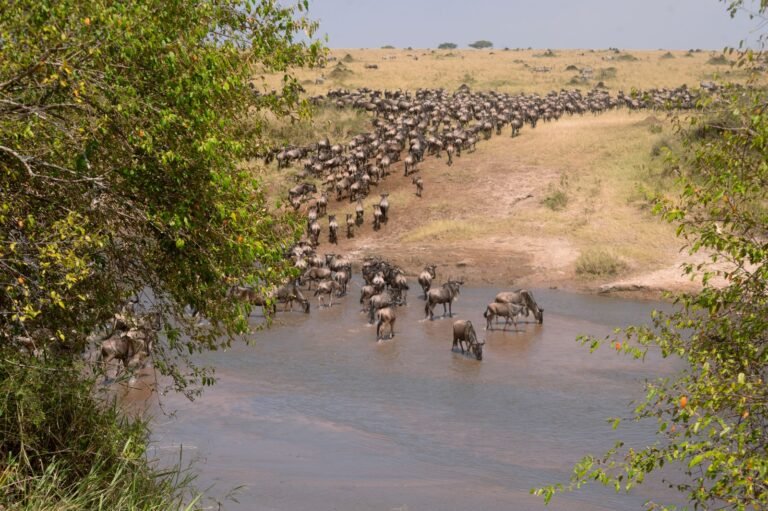
The Masai Mara works differently and cheaper in the low season. The Narok County tariff, reported by the Daily Nation and corroborated across four other sources, is US$100 a day from January to June and US$200 a day from July to December for a non-resident adult, each ticket valid 12 hours, 6am to 6pm (nation.africa). Arrive on 30 June instead of 1 July and your daily fee halves — a timing trick worth real money on a multi-day trip. The catch: the low-fee months are the months without the migration river crossings, so the saving is real but it buys a different safari.
One more grounding number: in Tanzania’s 2024 International Visitors’ Exit Survey — 15,000+ departing visitors, run by the tourism ministry, the Bank of Tanzania and the statistics bureau — package wildlife-safari visitors spent $586 per person per night in-country, excluding international flights (reported by getsafaritours.com). That is what real visitors actually spent, not what any operator advertises. If your Tanzania quote is far below that, something is missing — usually the fees, the internal flights, or both.
Two worked trips
Seven days, mid-range, Kenya — roughly $3,800–$5,200 per person. That is Rex Clarke Adventures’ figure from 2026 operator rate cards (rexclarkeadventures.com), and it is the cleanest single number in this guide: a week in the Masai Mara and one other reserve, mid-range lodges, internal flights included at the upper end. Add international flights, the visa, tips and a Nairobi hotel night on either side, and the real trip total lands closer to $5,000–$6,500 per person.
Ten days, luxury, Kenya and Tanzania — roughly $15,000–$30,000 per person including internal flights. Again Rex Clarke Adventures (rexclarkeadventures.com). The range is wide because luxury is wide: a $15,000 trip and a $30,000 trip can both be called luxury, and the difference is the camp, the conservancy and the season. What both ends share is that the internal flights are included — on a two-country luxury trip they are a four-figure line item, and a quote that omits them is not a quote.
GetSafariTours’ own 2026 bands frame the same market slightly higher: budget $120–$400, mid-range $400–$900, luxury $900–$3,000 per person per day, with a private mid-range Tanzania week at roughly $3,870 per person for a couple in high season (getsafaritours.com). The honest conclusion from all the sources: budget $350–$750 a day for mid-range, expect the quote to land somewhere inside that band, and be suspicious of anything far outside it in either direction.
The costs nobody puts in the headline
International flights. Excluded from every per-day figure in this guide and in every operator quote. Price them separately and early — they are the single biggest variable in the trip total.
Internal flights. A bush flight between camps is a real line item. In the Okavango, for example, operators quote $350–$700 per person per leg (cheetahsafaris.com). A three-camp itinerary can add $1,000+ per person in flights alone.
Visas. Tanzania charges $50 for a standard visa and $100 for US citizens (multiple-entry), per the Bwindi guide’s figures (bwindiforestnationalpark.com). Check the official portal for your nationality before you budget — visa fees are the easiest line to get wrong.
Tips. The figure most guides give in one line and never total up: roughly $15 per person per day for the guide, per exploreafrica.com.au, and $15–$20 a day for the guide plus $10–$15 a day for camp staff, per travelmapguide.com (a single source — treat it as a guide, not a rule). Over seven days that is $175–$245 per person. Budget it before you go, in cash, in small notes.
Pre- and post-safari hotel nights, insurance and vaccinations. You will almost always need one night near the airport at each end — two nights at $80–$150 is $160–$300 no per-day price includes. Yellow fever vaccination is required for entry to Kenya, Tanzania, Uganda and Rwanda, at least 10 days before travel — carry the certificate. Insurance that covers medical evacuation from a remote camp is not optional; price it, do not skip it.
Single supplement. Travelling alone? Safarisync puts the single supplement at +30–50% (safarisync.com). A $350-a-day mid-range trip becomes $455–$525 a day for a solo traveller. Some camps waive it in the green season — ask, do not assume.
Add those up for a 7-day mid-range Kenya trip and the extras run roughly $800–$1,500 per person on top of the $3,800–$5,200 package. That is the number to plan around, not the headline.
How to cut the cost without cutting the safari
Go in the green season. The Bwindi guide puts green-season discounts at 20–50% (bwindiforestnationalpark.com), and some Okavango camps charge roughly half their peak rates. The trade is real: afternoon rain, taller grass, fewer animals at waterholes — but the parks are greener, the birds are better, and the camps are quieter.
Join a group departure. A shared-vehicle group camping trip is the budget tier for a reason: the vehicle, guide and camp costs split across six or eight people instead of two. The wildlife is the same; the schedule is not yours.
Fewer parks, more nights. Every park move costs a flight or a long drive and a new set of fees. One park for five nights beats three parks for two nights each — you see more, and you pay less per day.
The cheapest legitimate safari: Kruger self-drive
South Africa’s Kruger National Park is the one place where the budget floor is real, because you can drive yourself. The daily conservation fee for an international adult is R602 under the SANParks tariff running 1 November 2025 to 31 October 2026, rising to R692 from 1 November 2026 (hoedspruit.co.za, kruger-nationalpark.org and lekkeslaap.co.za, all citing the SANParks tariff). A rest-camp bungalow at Lower Sabie runs roughly R1,800–3,000 a night for two (next-stop-anywhere.com). Add a hire car and fuel, and two people can do Kruger for roughly $80–$150 per person per day — the bottom of the South Africa budget band above, and the reason that band starts so low.
The honest downside: Kruger self-drive is not the same product as a guided East African safari. You drive yourself, you find your own animals, and the southern section around Skukuza and Lower Sabie is busy — the densest game and the most visitors in the same place. If you want a guide, a full-day guided safari from Hoedspruit costs from R1,560 per adult including vehicle and guide, with park fees extra (hoedspruit.co.za, operator’s own rate, 5 October 2026). That is still a fraction of a fly-in camp, and it is the right middle step between self-drive and a full lodge package.
One more warning that belongs in a cost guide and nowhere else: the cheapest safari is only cheap if it is legitimate. Group camping trips at $80 a day exist in the listings — but the budget floor in this guide is $125 a night (SafariBookings) for a reason. Below that, check what is missing: usually the park fees, the food, or the licence. A safari that excludes its own park fees is not a bargain; it is a bill that arrives later.
How much does an African safari cost per person per day?
SafariBookings’ published averages are $150 a night for budget, $350 for mid-range and $750 for luxury, within an overall range of $125–$1,500 per person per night (safaribookings.com). The realistic mid-range band most first-timers book is roughly $350–$750 per person per day before international flights (castawaychris.com). The country matters: Kenya and South Africa run cheaper than Tanzania and Botswana at the same tier.
How much is a 7-day African safari?
A 7-day mid-range Kenya trip runs roughly $3,800–$5,200 per person (rexclarkeadventures.com, 2026 rate cards). Add international flights, visas, tips, insurance and a hotel night at each end, and the real total is closer to $5,000–$6,500 per person. A 10-day luxury Kenya–Tanzania trip runs roughly $15,000–$30,000 per person including internal flights.
What is the cheapest way to do an African safari?
Self-drive Kruger National Park in South Africa. The conservation fee is R602 per international adult per day (R692 from 1 November 2026, SANParks tariff), a rest-camp bungalow runs roughly R1,800–3,000 a night for two, and two people sharing a hire car can do Kruger for roughly $80–$150 per person per day. Group camping departures in East Africa are the next cheapest legitimate option, from around $125–$150 a night.
Are park fees included in safari prices?
Usually, but not always — and the fees are large enough to matter. In the Serengeti, entry ($82.60 per 24 hours) plus the in-park concession fee ($70.80 per night) stack to roughly $153 a day before anything else. Always ask an operator to confirm in writing that park and concession fees are included, and check the current tariff yourself: TANAPA re-sets its fees every July, SANParks every November.
How much extra should I budget for tips, visas and internal flights?
Roughly $800–$1,500 per person on a 7-day mid-range trip. Tips run about $15 per person per day for the guide, plus $10–$15 a day for camp staff; a Tanzania visa is $50 ($100 for US citizens); internal bush flights run $350–$700 per leg in places like the Okavango; and you will need a hotel night near the airport at each end. None of these appear in the headline per-day price.
Is a safari cheaper in the green season?
Yes — green-season discounts run 20–50% on lodges and camps (bwindiforestnationalpark.com), and some Okavango camps charge roughly half their peak rates. The trade is afternoon rain, taller grass and fewer animals concentrated at waterholes, against greener parks, better birding and quieter camps. November and April in East Africa are the best-value months for a first safari.
Closing
A safari is expensive because the costs are real: park fees that run $100–$200 a day before you sleep anywhere, small camps in remote places, and guides whose knowledge is the whole product. The price is not a mystery once you see the stack — and once you see it, you can choose where on it to sit. Most first-timers should sit in the middle: mid-range, one country, five to seven nights, booked in the green season if the budget is tight. That is a $3,800–$5,200 trip, honestly priced, and it is the best money in travel. Start with our African Safari Beginner’s Guide to pick your country, then read our Serengeti Safari and Masai Mara Safari guides to compare the two great migration parks, and browse the African Safaris hub for the rest.



4 Comments